
Key Takeaways
- Texas drug possession and possession with intent to deliver are separate offenses, with intent-to-deliver charges potentially carrying longer prison sentences and increased fines.
- Simple possession requires proof that you knowingly or intentionally possessed a controlled substance, while intent to deliver needs evidence that you planned to transfer it to someone else.
- Prosecutors can use drug quantities, packaging materials, cash, digital scales, electronic communications, and witness testimony to establish intent to deliver without evidence of a completed sale.
- Texas drug penalties depend on the substance’s penalty group, its quantity, and the alleged offense, with drug-free-zone enhancements and prior felony convictions potentially increasing punishment.
- A drug distribution conviction can affect employment, housing, professional licensing, immigration status, and property ownership through civil asset forfeiture proceedings.
- A criminal defense attorney can challenge unlawful searches, disputed possession, evidence of intent, laboratory results, and witness testimony while seeking reduced charges, dismissal, or acquittal.
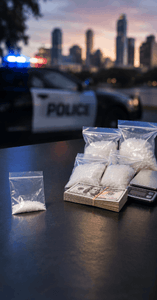
If police find illegal drugs in your vehicle, home, or belongings, you could be charged with drug possession or possession with intent to distribute. However, the charge depends on the type and quantity of drugs involved. Police may also look for evidence that you intended to sell or deliver them, such as packaging materials, cash, or text messages discussing drug transactions.
At the Law Office of Amanda Skillern, we represent clients facing drug charges in Houston and throughout Harris County. Attorney Amanda Skillern’s background as a former prosecutor gives us insight into how the state builds these cases, and we use that information to get the best results for you. In this guide, we explain the differences between the two offenses and how prosecutors establish intent to deliver.
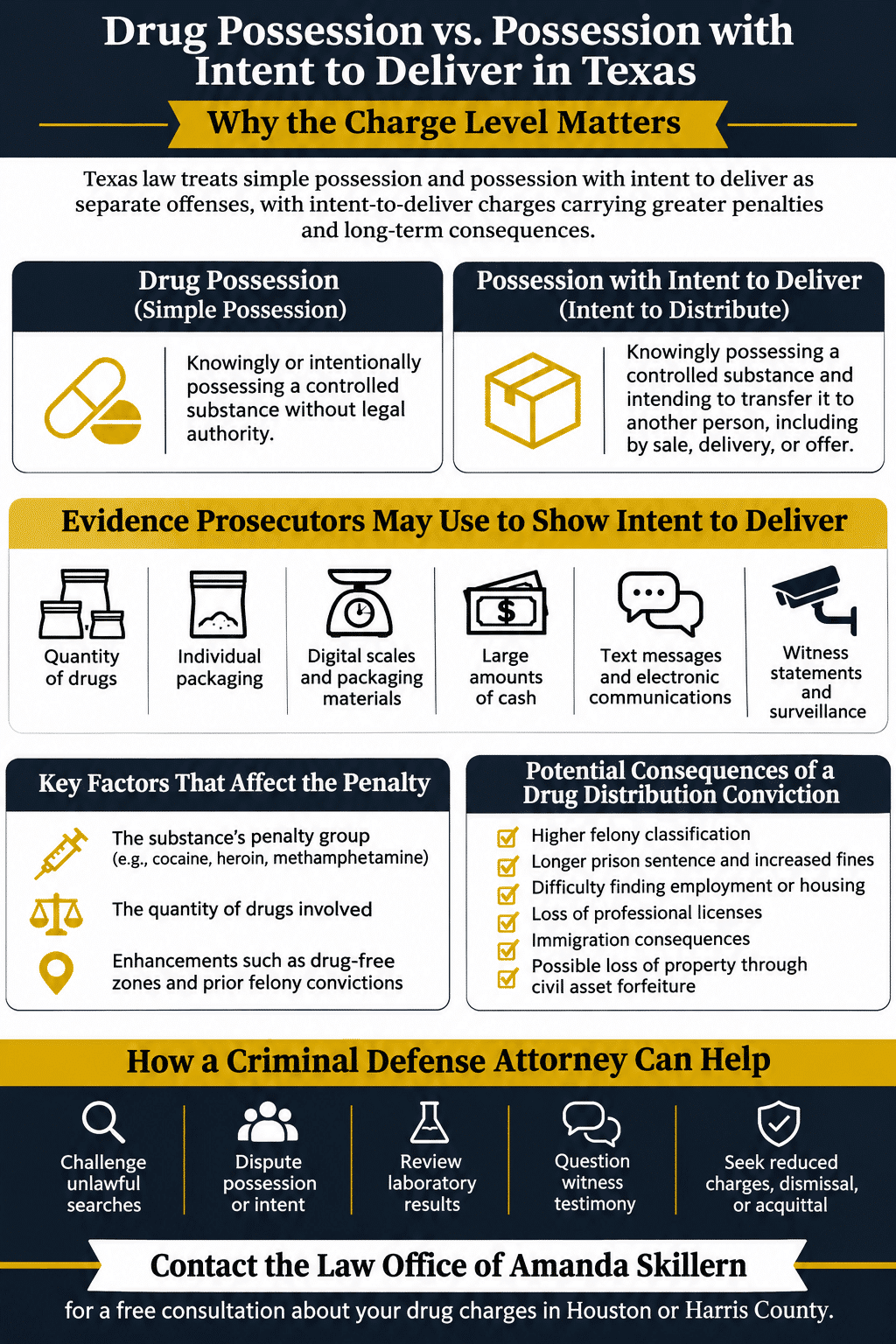
What Is the Difference Between Drug Possession and Possession with Intent to Deliver in Texas?
Under the Texas Controlled Substances Act, simple possession and possession with intent to deliver are separate criminal offenses. Both involve knowingly possessing a controlled substance without legal authorization. However, possession with intent to deliver requires prosecutors to prove that you also intended to provide the drugs to someone else.
What Constitutes Simple Drug Possession?
Texas Health and Safety Code § 481.115 makes it illegal to knowingly or intentionally possess a controlled substance in Penalty Group 1 or 1-B without the authority to do so. Possession is described in two forms:
- Actual Possession: You have direct control over the substance, such as carrying drugs in your pocket or holding them in your hand.
- Constructive Possession: You know the drugs are present and exercise control over them, even though they aren’t on your person. For example, you have drugs stored in a bedroom or vehicle.
Simply being near illegal drugs doesn’t establish possession. Prosecutors must prove that you knew the substance was contraband and exercised control over it.
What Constitutes Possession with Intent to Deliver?
Texas Health and Safety Code § 481.112 prohibits knowingly possessing Penalty Group 1 drugs with the intent to deliver them. Under § 481.002(8), delivery includes transferring drugs to another person or offering to sell them.
This means prosecutors don’t have to prove that you completed a drug sale. They can pursue charges based on evidence that you intended to distribute the drugs. This difference impacts the potential punishment. For example, possessing two grams of cocaine is a third-degree felony, while possessing the same amount with intent to deliver is a second-degree felony.
How Do Prosecutors Determine if You Intended to Distribute Drugs?
Prosecutors don’t need to prove that you sold drugs to establish intent to deliver. Instead, they can use direct or circumstantial evidence to show that you planned to transfer the drugs to another person. Texas courts consider several factors when evaluating these allegations, including the quantity of drugs, their packaging, and other items found during the investigation.
Common Evidence Used to Establish Intent to Deliver
Police may collect several types of evidence during a drug investigation. Prosecutors can then use that evidence to argue that the drugs were intended for distribution rather than personal use.
- Quantity of Drugs: Prosecutors may argue that the amount of drugs you possessed exceeds what someone would ordinarily keep for personal use. They may also introduce testimony from law enforcement officers about quantities associated with drug sales.
- Individual Packaging: Drugs divided into small bags or containers may suggest preparation for individual sales. Investigators may examine the number of packages and the quantity contained in each.
- Digital Scales and Packaging Materials: Scales, empty plastic bags, and other supplies may indicate that drugs were being weighed and packaged for distribution.
- Large Amounts of Cash: Prosecutors may associate substantial amounts of cash with drug sales, particularly when police discover drugs and other distribution-related items nearby.
- Text Messages and Electronic Communications: Messages discussing drug prices, quantities, meeting locations, or planned transactions may indicate an intention to sell or transfer controlled substances.
- Witness Statements and Surveillance: Testimony about suspected drug transactions, surveillance footage, and observations of exchanges may help prosecutors establish intent to deliver.
Can You Be Charged with Intent to Deliver Without Selling Drugs?
Yes, prosecutors can charge you with possession with intent to deliver even if police never witnessed a drug sale. However, the state must prove that you possessed the drugs and intended to deliver them. The presence of cash, scales, or packaging materials doesn’t establish guilt by itself, as these items are not always related to drug distribution.
How Do Texas Drug Penalty Groups Affect the Charge Level?
The Texas Controlled Substances Act establishes the following categories:
- Penalty Group 1: Includes cocaine, heroin, methamphetamine, and certain other controlled substances.
- Penalty Group 1-A: Includes LSD and certain related hallucinogenic substances. Penalties are based on abuse units rather than grams.
- Penalty Group 1-B: Includes fentanyl and certain fentanyl derivatives. Texas establishes separate penalties for possessing, manufacturing, or delivering these substances.
- Penalty Group 2: Includes substances such as MDMA (ecstasy) and certain hallucinogens.
- Penalty Group 2-A: Includes certain synthetic cannabinoids, with separate penalties for possession and delivery.
- Penalty Groups 3 and 4: Include certain prescription medications and substances containing regulated narcotics.
Drug Possession vs. Intent to Deliver: Texas Penalties Compared
As we’ve indicated, Texas imposes different penalties for drug possession and possession with intent to deliver. In many cases, an intent-to-deliver charge carries a higher felony classification than simple possession involving the same amount of drugs.
Penalty Comparison for Penalty Group 1 Drugs
The following penalties apply to Penalty Group 1 substances, including cocaine and methamphetamine.
| Drug Quantity | Simple Possession | Possession with Intent to Deliver |
| Less than 1 gram | State jail felony | State jail felony |
| 1 to less than 4 grams | Third-degree felony | Second-degree felony |
| 4 to less than 200 grams | Second-degree felony | First-degree felony |
| 200 to less than 400 grams | First-degree felony | First-degree felony, with a 10-year minimum sentence |
| 400 grams or more | First-degree felony, with a 10-year minimum sentence | First-degree felony, with a 15-year minimum sentence |
These classifications apply to Penalty Group 1 substances. Other drugs, including fentanyl and LSD, have different penalty provisions.
What Are the Potential Prison Sentences?
Under Texas Penal Code §§ 12.32–12.35, felony convictions have the following punishment ranges:
- State Jail Felony: 180 days to two years in a state jail facility.
- Third-Degree Felony: Two to ten years in prison.
- Second-Degree Felony: Two to twenty years in prison.
- First-Degree Felony: Five to 99 years or life imprisonment.
Each classification also supports fines of up to $10,000. However, certain drug offenses involving larger quantities have higher fines and increased minimum prison sentences.
What Factors Can Increase the Severity of Texas Drug Charges?
Drug quantity and penalty group aren’t the only considerations that affect punishment. Texas law also permits increased penalties for certain drug offenses committed near protected locations. Prior felony convictions can also increase the potential sentence.
Drug Quantity and Weight Calculations
In Texas, drug quantities are measured by aggregate weight, including adulterants and dilutants. This means substances mixed with the controlled drug may count toward the total weight. For example, a mixture containing three grams of cocaine and two grams of an added substance may fall within the five-gram category. Laboratory testing and weight measurements can therefore affect the felony classification.
Drug-Free Zone Enhancements
Texas Health and Safety Code § 481.134 increases penalties for drug offenses committed in designated locations. These include areas within 1,000 feet of school property and certain playgrounds. The punishment increase depends on the drug offense and the location involved.
Prior Criminal Convictions
Under Texas Penal Code §§ 12.42 and 12.425, prior felony convictions can increase punishment for a subsequent felony offense. For example, a third-degree felony may be punished as a second-degree offense if the defendant has a prior felony conviction. These enhancements can increase the prison sentence beyond the range ordinarily associated with the original charge.
What Are the Long-Term Consequences of a Drug Distribution Conviction?
A conviction for possession with intent to deliver can affect your future long after you’ve completed your sentence. Beyond imprisonment and fines, a felony drug conviction can create barriers that include:
- Employment Opportunities: Employers may consider your criminal record when making hiring decisions. Certain convictions can also prevent you from obtaining or renewing professional licenses.
- Housing Applications: Landlords may review your criminal history and deny rental applications based on felony drug convictions.
- Educational Opportunities: A conviction may restrict admission to certain academic programs or interfere with professional training requirements.
- Immigration Consequences: Non-U.S. citizens convicted of controlled substance offenses may face deportation or restrictions on immigration benefits under federal law.
- Property Forfeiture: Under Texas Code of Criminal Procedure Chapter 59, authorities may seek forfeiture of cash, vehicles, or property connected to certain drug offenses.
Civil asset forfeiture is separate from criminal prosecution. Texas law permits forfeiture proceedings even without a criminal conviction, although the government must establish that the property is subject to forfeiture.
How Can a Criminal Defense Attorney Challenge Drug Possession with Intent to Deliver Charges?
- Challenging Unlawful Searches and Seizures: Police must have a lawful basis to search your vehicle, home, or belongings. Your criminal defense attorney can examine the search warrant, the grounds for a traffic stop, and claims of consent. Under Texas Code of Criminal Procedure Article 38.23, illegally obtained evidence may be excluded from trial.
- Disputing Knowledge or Possession: Drugs found in a shared vehicle or residence don’t necessarily belong to you. Your drug crimes defense attorney can challenge claims that you knew the drugs were present or exercised control over them.
- Challenging Evidence of Intent to Deliver: Cash, scales, and packaging materials don’t necessarily prove an intention to distribute drugs. Your attorney can question the prosecution’s interpretation of these items and present explanations unrelated to drug sales.
- Reviewing Laboratory Results: Drug testing can establish the substance’s identity and measured quantity. Your attorney can examine laboratory reports, testing procedures, and evidence handling records for errors that may affect the charges.
- Challenging Witness Credibility: Witnesses may provide conflicting statements or have incentives to cooperate with prosecutors. Your attorney can investigate inconsistencies and question their testimony.
- Negotiating Reduced Charges: If the prosecution has insufficient evidence of intent to deliver, your attorney may seek a reduction to simple possession. Any agreement depends on the charges, evidence, and prosecutor’s approval.
A successful defense may result in reduced charges, dismissal, or acquittal. The available strategies depend on the evidence and the legal issues identified during the investigation.
FAQs About Drug Possession vs. Possession with Intent to Distribute
Can I Be Charged with Intent to Deliver if I Never Sold Drugs?
Yes. Texas Health and Safety Code § 481.112 allows prosecutors to charge you with possession with intent to deliver without proof of a completed sale. However, the state must prove that you knowingly possessed the drugs and intended to transfer them to another person.
Does Having a Large Amount of Drugs Mean I Intended to Sell Them?
No. Drug quantity is one factor prosecutors consider when attempting to establish intent to deliver. They may also examine packaging materials, cash, communications, and witness testimony. A large quantity doesn’t establish intent by itself.
Can Possession with Intent to Deliver Be Reduced to Simple Possession?
Yes. Prosecutors may agree to reduce an intent-to-deliver charge to simple possession through plea negotiations. Your attorney can challenge the evidence of intended distribution and seek a reduction when the prosecution’s case doesn’t establish that element.
Questions? Talk to a Houston Drug Crimes Defense Lawyer Now
The difference between drug possession and possession with intent to deliver can affect the charges you face and the potential punishment. An intent-to-deliver allegation may result in a higher felony classification, longer prison sentence, and increased fines. However, prosecutors must prove that you knowingly possessed the drugs and intended to deliver them to someone else.
At the Law Office of Amanda Skillern, we defend those accused of drug crimes in Houston. Attorney Amanda Skillern draws on her experience as a former prosecutor to examine the state’s case and challenge criminal allegations. To schedule a confidential case evaluation, call us at 832-954-4722 or contact us online today.

Contrary to popular belief, Lorem Ipsum is not simply random text. It has roots in a piece of classical Latin literature from 45 BC, making it over years old. Richard McClintock, a Latin professor at Hampden- Sydney College in up one of the more obscure Latin words, consectetur.